____________________________________________________ This is a project developed within Porto Comunidade, a colective project taking place in the city of Porto, more precisely in Praça da Batalha, with performances at 13 and 14 of October, 2008. The project has been conceived and initiated by choreographer Emre Koyuncuoglu (Istambul) and the film curator Tobias Hering (Berlim), and is hosted by José Roseira and Ideias Imergentes ctrl. ____________________________________________________
The Bucket Team: Jorge Gonçalves (dancer) João Pádua (photographer) Joana Mateus (Visual/sound and performance artist) Manuela São Simão (visual/performance artist and blogger) ____________________________________________________
Contact us to: bucket.project08 [at] gmail [dot] com ____________________________________________________
____________________________________________________ João and Joana, with some help of Tobias, take off the posters from Batalha Teathre vitrines as part of the final performative actions of this first day presentation. ____________________________________________________ These photos were taken on Monday, the first day of the performance. All images in this project are taken by the photographer João Pádua.
Besides photographies, there were also recorded some field recordings in streets during the "bucket collection"process the week before the final presentations. These sounds and excerpts from conversations asking people for the buckets were made by the visual and sound artist Joana Mateus and I will document this material as soon as I can, as it is a very complete ad rich part of this "work in progress" project that Joana created as her "voyeuristic" documentation of this important process. ____________________________________________________
____________________________________________________ Here are some photos of Jorge performing with the buckets inside this "ghost fountain" that is no longer filled with water... Here the buckets appear as some strong suggestion and metaphor for the water. There is also a small video documentation of this action, less subtil than the posters, and more assumed as a teather/dancing performance inside this ghost-fountain-stage in Praça da Batalha. ____________________________________________________
São quase 18h e estou sentada no banco, em plena praça da Batalha, frente ao Teatro com o mesmo nome.
Tenho à minha frente um senhor de idade, curioso, que ainda não percebeu porque é que eu estou aqui sentada ao pé dele, escrevendo e filmando, com um computador no meu colo…Ele olha fixamente para tentar perceber o que faço e para onde olho, mas acaba por desviar o olhar para, talvez, tentar perceber o que estou a filmar, ou então simplesmente a situação deixa de o interessar...
A minha intervenção neste projecto é, neste momento, documentar o que se vai passando em torno de mim, aqui na praça, completando esta “comunidade física”, com a também legítima comunidade virtual.
Pretendo que esta tome conhecimento do projecto através do blog que eu privilegío enquanto o espaço público virtual por excelência, que permite o feedback constante por parte daqueles que o visitam, uma manifestação que, tal como em praça pública, também é possível.
Esta comunidade virtual, acaba por ser tanto aquela que viveu a experiência no espaço público real, como aquela que, por diversos e legítimos motivos não pôde estar presente mas pôde “visitar” o projecto que, sendo efémero, encontra no blog uma continuação.
Entendo este espaço da “web social” como mais do que uma simples forma de documentar a realidade social in situ.
Este espaço acaba por funcionar como um espaço público paralelo e específico, onde a intervenção aqui feita também “serve” uma comunidade - a virtual - que tem as suas especificidades, timings, prioridades e preconceitos também!
O projecto que aqui é desenvolvido acaba por transcender a intenção meramente documentativa, assumindo-se como “visão parcial” porque pessoal e mesmo voyerista de cada um dos intervenientes neste Bucket Project: seja através de um texto, de uma fotografia, de um excerto sonoro de uma conversa na rua ou uma coreografia.
Por isso a Emre me pediu para (se iríamos criar o blog como complemento do nosso Bucket Project) que o fizéssemos no próprio espaço público em plena praça da Batalha para desta forma viver o momento e tentar mostrar parte dele à comunidade virtual.
Vejo à minha volta algumas pessoas mas não lhes posso dar a atenção que quero nem tentar perceber as suas expressões e até curiosidade no que os meus colegas andam a fazer.
Tento ir observando e relatando o que vejo e estou com uma câmara compacta na mão (não sei como consigo fazer as duas coisas ao mesmo tempo!) para ir filmando em pequenos vídeos o que o João e a Joana estão a fazer neste momento.
Eles estão à minha frente a colocar os posters gigantes que foram impressos a preto e branco, com as fotografias tiradas pelo João durante a “recolha de baldes” na semana passada, em que fomos todos juntos a diversas lojas de comércio aqui da zona da Batalha, pedir alguns baldes para a nossa “colecção”.
Ao colocarem os posters eles parecem-me ser interceptados por algumas pessoas que passam por eles curiosas e olham bastante ou chegam a perguntar algo, mas não dá para perceber o quê…
Talvez porque as imagens tenham impacto e são suigéneris (por todas representarem pessoas a segurarem baldes nas mãos), ou também porque eles estão a colocar aqueles cartazes à luz do dia e nesta altura é raro ver movimentação naquelas vitrines com tanto “cola e descola” cartazes!
De qualquer das formas, esta acção que eles desenvolvem, este montar de uma exposição em espaço público entendendo a praça como galeria, acaba por ser um gesto performativo que queremos súbtil e que quase se pode camuflar nesta praça.
Entendo como uma “acção-site-specific” que se (con)funde com os gestos quotidianos desta comunidade da Batalha. A curiosidade e o que mais “intriga” nesta acção, é o facto de, embora seja um gesto perfeitamente aceitável como parte (possível) de um quotidiano deste local, acaba por convocar situações de “déjà vu” ou até mesmo “déjà-non-vu” que obriga os transeuntes a olharem duas vezes e se questionarem: “Porque estarão estes jovens a colar cartazes a esta hora do dia?”; “Para quê tantas imagens de baldes?”. Ocorrem-me certas perguntas e tento colocar-me no lugar de um transeunte embora tenha noção que a minha atitude é extremamente especulativa...
E isto é o que vou observando na minha posição “viciada” de fruidora/produtora que ao ser participante neste projecto, não consegue de uma forma imparcial (nem tenho essa pretensão) me colocar na pele do observador passageiro e sem tempo para muito questionar...
A curiosidade e vontade de saber quais as ideias e opiniões que o público portuense da zona downtown do Porto tem acerca da arte e das suas formas de se assumir no espaço público, levou-nos a entender a procura dos baldes como uma “busca” de uma série de feedbacks que de certa forma sintetizamos nesta “desculpa do balde”.
Para isso decidimos ir directamente contactara comunidade que seria, daí a uma semana, o público circundante que iria “receber” este nosso projecto de intervenção específica na praça da Batalha.
Ficam aqui algumas intenções, intervenções e especulações, e fica também este espaço como um livro de visitas virtual, um projecto que reúne informação lado a lado com a possibilidade de comentário e de (re)acção por parte de qualquer “transeunte virtual” que, mais ou menos apressado, aqui queira deixar o seu comentário, mais ou menos simpático, mais ou menos preconceituoso, mais ou menos especializado, mais ou menos previsível! Tal como também acontece na rua, este espaço é legítimo por tratar-se de um espaço público como outro qualquer, onde podemos encontrar de tudo um pouco, não é verdade? :)
Não tenho mais tempo para escrever pois o Jorge começa de seguida a performance com os baldes na fonte-fantasma! Obrigada pela visita! Sintam-se à vontade para comentar aqui ou através do e-mail: bucket.project08 [arroba] gmail [ponto] com
Apareçam de novo amanhã, virtual ou físicamente! :)
Some of these buckets, were given us, by Sr. Silvino from Café Tropical, Sr. Carvalho from Café Chave D`Ouro, Sr. Carlos Afonso from Café Paula, Dona Maria do Carmo from Café Bocage, Dona Ana Pereira from Café Paulista, Sr. Ricardo from Pastelaria Bom Gosto 2, Sr. Carlos Miguel from Teatro S. João, Dona Emília do Porto Ginginha, Ying Chen da High Seat store. ____________________________________________________ Thanks for the help in our "Bucket Collection"! :) Some of the images that João took, were resized to a bigger size to be printed for one of this Bucket Project performative actions, in which we will be putting the posters with the borrowed buckets in the vitrines of Batalha Theatre. ____________________________________________________
These first 3 buckets were borrowed to us by Sr. Fernandes from Talho Batalha, Sr. Martins from Java Café and Sra Maria Lurdes Nobre from Confeitaria Batalha.
And some of them may also borrow us another one, for us to use in the days of the intervention at the square. Thanks! :) ____________________________________________________
____________________________________________________ With the main idea of Community and the intention and will of getting the community directly involved in this project, we decided to ask for something to the people around the intervention places (Praça da Batalha) like inhabitants or people in the stores.
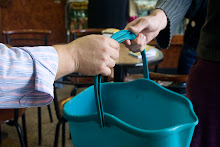
During the workshop days, before we start to work in these practical projects, we were asked by the choreographer Emre to bring some object we liked for proposing some idea around it. Jorge brought a Bucket, which was very suggestive and with which I identified myself with, and so it started to appear an affinity group of two bucket addicted!! :) But besides its appealing shape of bright and plastic colours, the bucket has a strong significance, of a container that helps people gathering something to make easier their work and transportation.
An old and used bucket is an object that gathers in itself all the work and suggests all the hands that handled it with more or less will, with more or less strength, with more or less happiness, with more or less certainty, with more or less love... An object that had different functions and that may also reflect all the emotions that people that handled it, brought to it.
To ask for a bucket to the people in the neighbourhood of Batalha, is also an excuse, for us to go to them and have the chance to speak an tell them about our project and see how they can or can´t be open to the participation, by simply borrowing us an old object of their daily use: What is this for? Why do we need it? What is it that is going to happen in the square? What project is this? What for is this? Who are we?
Everyone is invited to take part in this project, and yesterday the coloured buckets started to circulate around Batalha neighbourhood and here are some pictures of that simple and definitely not regular exchange of buckets for....what for??!! Manuela São Simão
____________________________________________________ The Bucket Team:
Jorge Gonçalves (dancer) João Pádua (photographer) Joana Mateus (Visual/sound artist) Manuela São Simão (visual/performance artist) _______________________________________________ Introduction:
This is a project developed within Porto Comunidade, a colective project taking place in the city of Porto, more precisely on Praça da Batalha, with performances at 13 and 14 of October, 2008. The project has been conceived and initiated by choreographer Emre Koyuncuoglu (Istambul) and the film curator Tobias Hering (Berlim), and is hosted by José Roseira and Ideias Imergentes ctrl.
"Concept for a site-specific choreography of film, text, performance, and discussion in public space in downtown Porto making use of scenes from the film La Commune – Paris 1871 by Peter Watkins (2000), and personal perceptions and projections of Portuenses on their city.
Like the film that it quotes and uses fragments of, Porto comunidade wants to encourage a critical and imaginative debate about one's community and one's own participation in it. Porto comunidade will develop a suggestive narrative of Porto's downtown informed by an interest in what is understood as "common". More specifically, the performance aims to create through the imaginary of art a temporary "community", a momentary political awareness that may initiate repercussions in the way people take part and responsibility in the real community of Oporto.
The film La Commune – Paris 1871 offers a complex experience that will inevitably strike various different chords in each audience. It re-enacts an extremely critical and powerful historical reference, the Paris Commune which formally lasted from March 18 till May 28, 1871. The film was made with mostly amateur actors, a majority of whom were in economically precarious or socially marginalized situations. Frequent, often controversial discussions on the film work itself and on the political issues at stake in the Commune were part of the project and are included in the final film.
La Commune – Paris 1871 not only recollects a pivotal historic moment. It is also the document of a collective process of self- empowerment through role play and debate. It has become a unique classic of political filmmaking through its attempt to use film and film work as a complex system of signs and actions, whose layers and facets – like those of society – cannot be represented in a definite and final shape, but will always remain open for re- enactment, re-instantiation and re-interpretation. For once, seeing an actor totally absorbing the rebellious vigour of his or her character and then turning on the camera and relating this experience to his or her real life as a political subject, does not leave the audience unchallenged. It opens the boundaries between fiction and reality, imagination and practice, and turns an expecting eye on the audience: What would you have done at the time? And what are you doing today? How are your connections to your community and its imagined possibilities?
By accentuating thematic suggestions of the film with the significance of the screening sites in Porto's downtown, and by developing a choreography of scenes, readings and gestures developed on-site with the performers, Porto comunidade will create a tangible and more specifically local context for this challenge. The piece interweaves several layers of reference, inviting both a cognitive and an imaginative approach. The layers will bring into play different times and modes of actuality, past, present, future, reality, transformation, utopia. These layers of reference could be identified as: What was? What is? What can be? But even in this tentative chronological order they immediately start intermingling, since inevitably whatever was and is, was and is surrounded by something that was not and is not, and therefore the question: Why did this not happen, and what would the present look like, if it had? This kind of dialogue about actualities and possibilities of the city is the main intention of the piece and ideally each performance would include a collective debate in which the audience can freely express their experience with this offer and thus become actors, that is: active. After all, it has been a driving force in theatre and performance art to investigate different forms of "being in the world" and to inform real life performance and behaviour by artistic explorations.
In Porto comunidade, the audience will be taken to a public space in the city which many of them will be familiar with as inhabitants, commuters, or visitors. They will be presented with performances, readings, film scenes, which can dislocate this familiarity and thus open up to an imaginary field of possibilities. The relation of the citizens to their city can never be defined, and might even escape a proper description. One of the fascinations of cities is the stark contrast between the seemingly rigid factuality of buildings, streets, monuments, and the constant flux of movement and use that the people make of this infrastructure. Even where this use does not leave a visible trace on the city's surface, it will contribute significantly to the character of a city, to what the city is in a given moment.
This constant friction and mingling of a rigid objectivity with a practical subjectivity also describes the way the individual relates to the community. The political as that which concerns everyone is etymologically bound to the city, the polis, as a space for the public expression of individual positions and the challenge to integrate these with each other. Artistic appropriations of public space tend to broaden the realm of this debate and have often served to revitalize it when it was threatened by too much routine or suppression. Porto comunidade is intended to stimulate a debate and understanding of the city as the "common concern" of everybody.
Reference: Former projects with La Commune The film La Commune – Paris 1871 has never received a wide commercial distribution, partly due to its sheer length of 368 minutes. It is frequently used, however, in specific thematic contexts, mostly supported by local initiatives who identify with the film's political scope and enjoy its richness of perspectives. This kind of non-commercial and community-specific use is encouraged and supported by "Le Rebond pour La Commune", a Paris-based initiative consisting mostly of participants in the film and dedicated to its distribution.
The project Porto comunidade has two predecessors. In 2006, Tobias Hering organized a screening of La Commune – Paris 1871 in public space in Berlin as part of the annual film festival "globale". The film was shown in its full length, divided into 10 chapters to be screened at different informal locations in a low-profile residential neighbourhood in the Eastern centre of the city. Since the location was changed several times throughout the screening, the concept included the idea of turning the "film walk" into a performance of its own right making use of public space in a unique and topical manner by claiming the film's issues to be issues for these spaces; and these spaces to be spaces for public political debate.
In a first collaboration of Emre Koyuncuoğlu and Tobias Hering in the Turkish Black Sea town of Sinop, excerpts of the film were made part of a narrative performance involving choreographed dance and theatre elements, readings, a live "tour guide", and a closing discussion with the audience in a wide open circle. Sinop Komün-ikasyon'u was part of the "Sinopale" 2006, an art biennial that was inaugurated that year. The specifics of the piece were largely influenced by the location, the former Sinop prison in a medieval fortress towering over the city and officially abandoned in 1996 after being in use as a state prison for over a century.
Notwithstanding its very specific local setting, the experiences made in Sinop in adapting a multi-layered performance piece to a historic will inform the production of Porto comunidade. Therefore, some aspects of this precedent project shall be discussed here, in order to outline possible dynamics.
Site specificity, in Sinop, meant to reflect on the anxieties, experiences, and preconceptions about the prison, its meaning for the local population as well as Turkey's political identity. Not only was this site by no means a public space; as a prison it was even the most dramatic counterpart to such an openness: a space of seclusion and segregation, a place whose entire raison d'etre was to hinder free movement and to control or break communication.
In the face of this, the "Sinopale" was meant to re-open this space, to make it accessible again and to invite audiences to come and claim it. This invitation was broadly embraced by the local public, for whom the prison had not only been a sinister landmark over their city, but also a stigma on their collective identity. Sinop was infamous for its prison throughout the country, a remote town on the Black Sea coast to which mostly "political" prisoners were exiled, people whose behaviour, action or thoughts had deviated from what was officially sanctioned as proper and conflicted with the interests of those in power. Interestingly, though, while Sinop prison became a place where thousands of people were locked away, disappeared and died for over a century, the small town around it developed a reputation for its relative tolerance towards political and religious convictions and became an exile for a heterogeneous population of people who were in political and/or legal trouble elsewhere.
For Sinop Komünikasyon'u, it was necessary to confront the almost over-determined gesture of organizing an art biennial in such a place. Inevitably this challenge meant to try to give a voice to the immensely conflictual narratives of the prison and ultimately to those who had been silenced there. Instead of performing and stretching the ideal openness of a "public space", Sinop Komünikasyon'u tried to perforate the visible walls and dominating limitations of discourse in and around Sinop prison and the political practices that took place there and are still taking place elsewhere. The piece used historic and contemporary texts, some written in and about Sinop prison, choreographed elements developed with 10 performers on the site, and scenes from the film La Commune – Paris 1871, which were screened in an accentuated manner, inviting imagination, interpretation and infiltration by performers and audiences. On each of three nights, the final part of the piece was a discussion among all participants – performers, organizers, and audience – sitting in a wide, open circle in one of the prison yards. Thus, Sinop Komünikasyon'u, by endorsing the gesture of the biennial, was an invitation to not only come, see, and listen, but to also take part, reply, and react to this invitation. This was broadly accepted by some 400 people on three nights, appropriating the space and contributing their own projections and experiences around and even inside the prison in three final debates, which gave each night its unique accentuation.
(Re-)Enactment: Enactment and re-enactment can be empowering experiences and are as such often employed in performance art. Generally, enactment facilitates the step from spectator to participant. Protected by the veil of a role one is more likely to become an "actor", therefore active, especially in public space organized by anonymity and the gaze. Yet, at the same time, this role play brings into focus the general disposition that in order to perform and be recognized in public one always has to assume a role, and therefore challenge the difference between "real" persona and enacted character. There is no guarantee that my performance will be interpreted or recognized as how I intend it; however, there is no other way of challenging misinterpretation and neglect than to step forward and act.
In Sinop, during a week-long on-site rehearsal, the performers – some professional, some not - developed visual interpretations to communicate with the untold stories and the unwitnessed history of the prison. These performances were meant to untie some of the critical knots which any debate about this site was to encounter, and to therefore breach the barrier of shame and ignorance that encloses many painful experiences, even when they have a collective relevance. The scenes from La Commune – Paris 1871 in turn were meant to open a broader context of reference for this debate. One of the film's most striking features is the unique engagement of the performers with their characters and the narrative they are performing. They frequently step out of their roles to freely express their reflections on the historic events they are re-enacting and to relate these to their actual real life experience." ____________________________________________________ http://emrekoyuncuoglu.googlepages.com/